
Session at the UN Science Summit 2026 LUMEN: Building Collective Intelligence Through Open and Responsible Innovation
September 23 | 2:00 pm – 4:00 pm
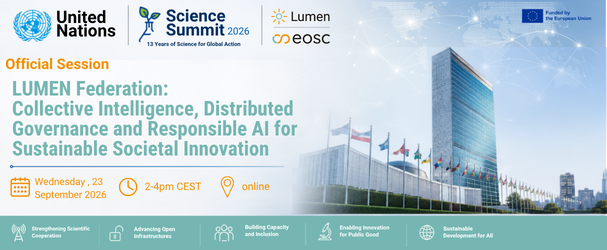
The LUMEN project takes its work to the UN Science Summit 2026 with an official online session: The LUMEN Federation: Collective Intelligence, Distributed Governance and Responsible AI for Sustainable Societal Innovation.
Rather than presenting a single project, this official UN Science Summit session uses the LUMEN Federation’s own experience as a living laboratory — exploring governance models and collaborative mechanisms that can transfer to other scientific, technological and societal ecosystems.
Across six thematic discussions, experts will examine how distributed governance, open science infrastructures, knowledge discovery, participatory design and responsible AI can strengthen collective capacity for innovation while preserving openness, trust and resilience. Each topic opens with the broader strategic challenge before turning to concrete examples from the LUMEN project itself: Introducing LUMEN, distributed governance, Meta-Search & Knowledge Discovery, Collective Design & Co-Creation, responsible AI in practice, and Open Science Ecosystems.
Participation is free and fully online. Institutions unable to join live are welcome to submit questions or priorities in advance. Register via the official UN Science Summit programme here.
Find more information about the LUMEN session here.
Agenda
The session will last 2 hours and will address six different topics related to collective intelligence. Each topic will be developed in 2 phases: a global and general one and then a concrete example given from the LUMEN project.
The session will begin with an introduction by Suzanne Dumouchel, setting the context for LUMEN, outlining the objectives of the session, and introducing the overarching vision of building a federation for collective intelligence.
The first topic will focus on “Introducing LUMEN: A Federation for Collective Intelligence”.
The second one will address “Distributed Governance as an Enabler of Resilience and Scale” by Mei Lin Fung focusing on community-driven governance models, distributed services and decision-making mechanisms, and approaches to balancing autonomy, coordination, and long-term sustainability.
Then we move to “Connecting Knowledge through Meta-Search and Knowledge Discovery” by Christophe Gauthier to explore how data mesh and meta-search approaches can make fragmented knowledge ecosystems more accessible, foster interdisciplinary collaboration, and support evidence-informed decision-making.
Data-mesh and meta-search: 2 applied examples from the LUMEN project by Julien Homo
The fourth topic “The Power of Collective Design and Co-Creation,” by Michela Magas will examine participatory methodologies, stakeholder engagement, agile development practices, and the role of diversity in driving creativity and innovation.
Reflections from practice – the LUMEN co-creation example by Stefano de Paoli
The fifth one “Responsible AI in Practice” by Sarah Nicole will address human-centered AI, governance mechanisms, transparency, safeguards, and approaches to building trust while accelerating innovation.
LUMEN example by Luca de Santis
Lastly, the session will conclude on “Embedding Innovation within Open Science Ecosystems” by Andrew Dubber and focus on collaboration with EOSC and European research infrastructures, interoperability, openness, knowledge sharing, and opportunities for international cooperation and scaling.