LUMEN Voices: CNRS
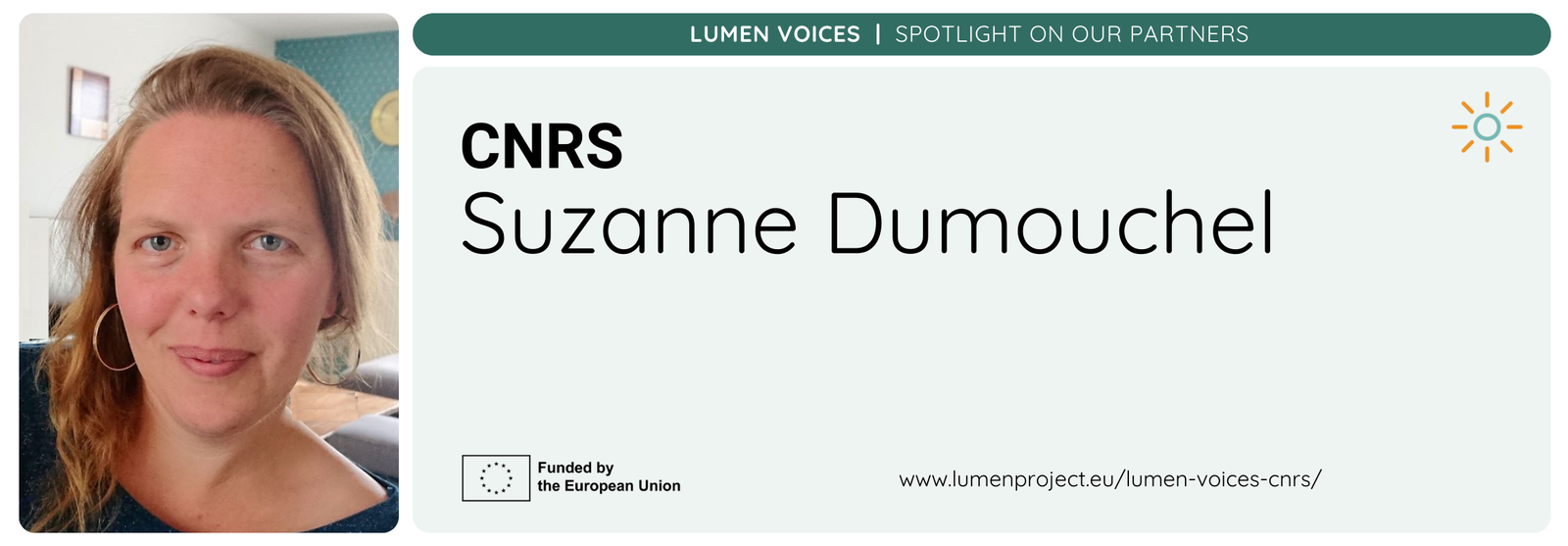
In this series, we share short interviews to introduce you to the diverse partners contributing to our LUMEN vision. Each month, we’ll shine a spotlight on two of our partners—offering a glimpse into who they are, what they do, and what drives their work within LUMEN. In this edition, Suzanne Dumouchel answered our questions.
Can you briefly introduce your organisation and its role within the LUMEN project?
CNRS is the world’s largest organisation in science, in most of the scientific domains. It is strongly dedicated to Open Science and the building of the EOSC. Within CNRS, several units are involved and represent the scientific communities in LUMEN. CNRS is the coordinating entity of the LUMEN project.
What is the most exciting aspect of your contribution to LUMEN, and how does it align with your organisation’s mission or values?
The most exciting aspect of our contribution to LUMEN is the opportunity to bring together different scientific domains, fostering cross-fertilisation and collaboration that will unlock new avenues of discovery. By working on the sustainability of various platforms and linking them with the EOSC Federation, we are helping to create an enduring, scalable infrastructure that will benefit researchers across disciplines. Additionally, supporting less advanced communities in terms of data harvesting and management aligns perfectly with CNRS’s commitment to promoting Open Science. All these efforts contribute to advancing CNRS’s mission to enhance knowledge sharing, accessibility, and innovation through Open Science.
LUMEN is all about interdisciplinary collaboration. How do you envision the project transforming the way research is
LUMEN is set to transform research by fostering a multiplication of synergies across disciplines, allowing researchers from diverse fields to collaborate more seamlessly and share knowledge in ways previously not possible. By integrating powerful discovery tools and AI-powered platforms, LUMEN will renew the experience of discovery, enabling researchers to find and access in an interoperable way some resources such as data, publications, codes, semantic artefacts, collaborators, across scientific domains more efficiently. This interdisciplinary approach will break down silos, accelerate innovation, and redefine how research is conducted, driving new breakthroughs by encouraging cross-pollination of ideas and methodologies across fields.
Looking ahead to 2027 and beyond, what impact do you hope the LUMEN project will have on the broader research community and beyond?
By 2027 and beyond, we hope the LUMEN project will have transformed the broader research community by establishing a highly interoperable, multidisciplinary ecosystem that significantly enhances cross-domain collaboration. Through advanced AI-powered tools and semantic technologies, a federated data sharing framework, and a FAIR-by-design approach, LUMEN will simplify the discovery and access of diverse scientific resources across domains such as Mathematics, Social Sciences and Humanities, Earth System Sciences, and Molecular Dynamics. This will foster greater innovation, accelerate research outputs, and expand the reach of Open Science by making data and knowledge more accessible, ultimately promoting interdisciplinary cooperation and driving new advancements across various scientific fields.