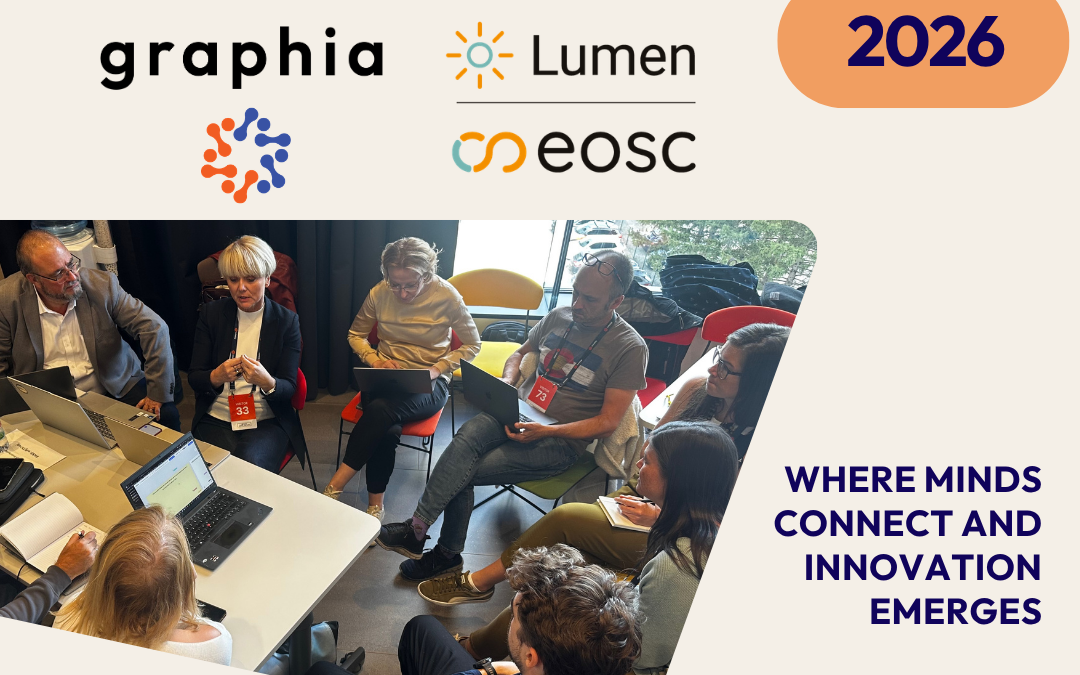
The Innovation Prototyping Lab (IPL) is a co-creation event that brings together the GRAPHIA and LUMEN communities for a dynamic week of collaboration, creativity, and connection.
In 2026, we are planning it at the CNRS offices in Brussels from 14-18th September. While in-person participation is limited to project partners and invited speakers, sessions in the main room are available for public streaming. Find the full programme at a glance here and a more detailed sessions overview below. Please note while the programme is finalised, we reserve the right to tweak it slightly if any needs for that arise.
The Satellite Event: White-Label Platform Beta will take place on Wednesday, the 16th of September 2026. Please note that this session will take place at the OPERAS Headquarters: Quai aux Briques 76 · 1000 Bruxelles, Belgium. Find more info below the schedule table for day 3.
Sign up for the livestream of the main room through this link (deadline Friday 11th September).
Day 1 (14 Sep)
All sessions are in the main room and live-streamed.
14:00 CET Welcome and Intro – GRAPHIA
14:15-15:15 CET – T4.3 Modules – This workshop aims at presenting the current state of implementation of three T4.3 modules: AI-based classifier, Autotagger NLP and Language Identification. The former is a module that performs automatic subject classification of input documents (e.g. publications from GoTriple), while the second is a module responsible for the extraction of named entities and properties from publications’ fulltext. Finally, the Language Identification service returns, given a textual input, the language in which it is written, together with the probability of this prediction, which can be used to filter possible uncertain results (which are usually wrong predictions) or give a “confidence” score to the user.
15:45-17:15 CET – Readiness Mapping for GRAPHIA Use Cases and Pilots with the OPERAS Innovation Lab Framework – This 90-minute hands-on session tests the OPERAS Innovation Framework (10 criteria for assessing innovative SSH outputs), developed in D4.1 of OPERAS-PLUS, against real GRAPHIA use cases and pilots. Use case owners apply the framework to their project in small groups. Then together, co-design a readiness map – a visual self-assessment instrument (not TRL-based) that each team can take away and continue using. The session also generates structured feedback on the framework itself, feeding into an updated version (v2) for the future.
Day 2 (15 Sep)
| Main Room (live-streamed) | Medium Room |
| 9:00-13:00 CET GRAPHIA Knowledge Graph: From Technical Update to Interface Co-Design | 9:00-13:00 CET Focus Work |
| This session pairs a technical update on the GRAPHIA federated knowledge graph (KG) with a co-design workshop on its user interface, also involving industrial players. The first part sets the scene: an overview of the KG’s overall architecture and infrastructure is followed by Net7’s proposals for the KG UI and Odoma’s presentation of the Quagga conversational agent. Participants will then test the KG UI hands-on and share feedback on the functionalities and UX elements most relevant to their community. The second part continues the brainstorming started at IPL 1 around the Quagga agent. After testing Quagga and sharing initial feedback, the group takes part in a guided brainstorm to imagine future interfaces beyond the conversational mode, arriving at ready-to-apply ideas. | An open breakout room for groups who want to work alongside the main-room session. |
| 13:00-14:00 CET Lunch Break | |
| 14:00-14:15 CET Welcome and Intro (main room) – LUMEN | |
| 14:15-15:15 CET Building LUMIS: Vision and Early Capabilities | 14:15-15:15 CET SSH Citation API |
| LUMIS is a collaborative environment that orchestrates open-source tools to build, manage, publish and maintain FAIR-by-design semantic artefacts, following industrial standards, methodology and best practices. LUMIS is currently in development, working toward an MVP ready for beta testing. This session gives a first live look at its capabilities ahead of that milestone. | This workshop aims at presenting to the consortium the SSH Citation Index API. Considering that it is due as a deliverable at M24, the feedback we will receive will be extremely useful for finalising the deliverable. The aim of the workshop is to present the API’s functionalities, demonstrates its usage, and gather additional requirements from stakeholders. |
| 15:45-17:15 CET EOSC Innovation Centre: KER Introductions and Panel | 15:45-17:15 CET Quagga-Benchmark Translatathon |
| Short introductions (5 to 10 minutes each) to LUMEN’s four Key Exploitable Results (White Label Platform; Federation of Platforms, which includes the Interdisciplinary Meta-Search Service; LUMIS; EOSC Innovation Centre), framing the EOSC Innovation Centre as a distributed, franchised methodology rather than a single facility, and as the KER that generates the other three. Followed by a moderated panel discussion. Nicki Lisa Cole (Know-Center) joins the panel to discuss instantiating a living-lab EOSC IC instance in Graz. | An organised translation effort aimed at translating already collected competency questions from Quagga into other languages. The idea is to leverage the linguistic diversity in the consortium and try to make Quagga data available in languages other than English (when possible, and based on language competencies available). |
Day 3 (16 Sep)
| Main Room (live-streamed) | Medium Room |
| 9:00-13:00 CET LUMIS Workshop: Beyond MVP | 9:00-10:45 CET Quagga Benchmark |
| LUMIS is a collaborative environment for building and managing FAIR-by-design semantic artefacts, currently in development toward an MVP for beta testing. This 4-hour workshop looks past that MVP: participants will review the remaining scope, evaluate its business criticality, estimate effort, and jointly prioritise what shapes the 2027 roadmap and beyond. | Curation of natural language phrases automatically generated from sparql by an LLM. This curation phase is part of the work on the Quagga benchmark being carried out in T4.1. |
| 11:00-12:30 CET GRAPHIA Business Portfolio | |
| The consortium has agreed that GRAPHIA will not deliver a single business plan but a portfolio of business models, one per KER or cluster of KERs. The four sustainability modes already on record are marketplace listing with community maintenance (KER1, KER5), collaborative open-source stewardship (KER2, KER4), institutional anchoring by RI partners (KER3), and fee-based consultancy and use-case licensing (KER6 and per-case exploitation). This 90-minute working session takes the four sustainability modes and works each in turn. | |
| 13:00-14:00 CET Lunch Break | |
| 14:00-15:30 CET Industry Panel | 14:00-16:00 CET The GRAPHIA Rulebook: Rules of participation to the federation |
| The panel discussion will include industry use cases representatives from the Industry Hub to further discuss the established use cases and explore opportunities on expanding them as well as explore new use case ideas. This will also give the opportunity to the audience to provide their feedback and also define further the value proposition for industry partners. | The GRAPHIA Rulebook defines the terms of reference–including governance, function, principles, roles, and scope–of the federation in order to guide its operations and ensure sustainability. As GRAPHIA T5.1 develops the Rulebook in close collaboration with the whole consortium, this workshop will be a validation exercise where GRAPHIA stakeholders may discuss the Rulebook contents. |
| 16:00-16:15 CET Special Issue on Co-creation: results and summaries of published articles | 16:00-17:15 CET Ontology Streamline – How Far Can we Delegate? |
| A short introduction to the special issue on co-creation of the CERN IdeaSquare Journal of Experimental Innovation, the issue launched at the first IPL, with results and summaries of the published articles. | LUMIS is a collaborative environment aims to make ontology engineering more accessible. This session starts with the basics: what an ontology is, how it’s built and used, then opens the floor to discuss which parts of ontology development could be delegated from experts to business owners or non-experts? |
| 16:15-17:15 CET Live Podcast Interview: Ravi Kapur with Andrew Dubber | |
| Ravi Kapur is the founder of Imperative Space, which works across the space sector with clients including the European Space Agency, the European Commission, EUMETSAT and the World Bank, and of ArtEO, a UK non-profit that gives artists access to Earth observation data. A former Nesta staffer who has also worked on UK government culture policy, he has a long-standing interest in knowledge graphs and co-creation. He joins Andrew Dubber for a live episode of Inside EOSC, the monthly podcast for the European Open Science Cloud. The episode is recorded live in front of the IPL audience and streamed to registered viewers. |
Satellite Event: White-Label Platform Beta: Please note that this session will take place at the OPERAS Headquarters: Quai aux Briques 76 · 1000 Bruxelles, Belgium
13:00-17:00 CEST
This session provides a comprehensive overview of the White-Label Platform and its Beta version, followed by a dedicated discussion with prospective users to gather early-stage development insights. Following the break, participants will engage in hands-on testing to evaluate the interface and initial functionalities.
Day 4 (17 Sep)
| Main Room (live-streamed) | Medium Room |
| 9:00-10:30 CET Early Curation of Metadata and Paradata for Building Knowledge Graph Compliant Datasets in Heritage Science Application | |
| This session explores how next-generation instruments, tools, and workflows are reshaping the production, integration, and reuse of data in SSH, with a focus on the heritage science domain. Building on the approach developed in GRAPHIA WP3, it will present a range of advanced instruments and tools supporting the improvement of SSH data lifecycle with semantically enriched datasets. In particular, three demos will be delivered: the workflow for enriching the catalogue of next-gen SSH instruments and tools through SSHOC, and ANAMNESIS a W7 based metadata management platform dedicated to data provenance. Finally, the mobile application Dür.air for digitisation activities will be showcased to demonstrate how next gen tools with built-in semantic layers can deliver Knowledge Graph-ready data. | |
| 11:00-13:00 CET LUMEN KERs Unique Value Proposition | |
| This session is a combined workshop and sprint to first brainstorm contents of individual partner exploitation plans and then a co-working sprint session wherein a representative from each partner drafts their exploitation plan using a template from the Horizon Results Booster service. | |
| 13:00-14:00 Lunch Break | |
| 14:00-16:00 CET LUMEN KERs Sustainability & Governance 1 | |
| This session is a workshop focused on sustainability and governance that aims to refine KER sustainability plans, identify governance model(s), and identify key actions to realise sustainability & governance plans for the WLP (+ components), LUMIS, Data Mesh Framework, and EOSC Innovation Center. This session builds on the KER sustainability plans developed through the first half of 2026 and develops content for D7.2. |
Day 5 (18 Sep)
All sessions will be in the main room and live-streamed.
09:00-10:30 CET – Dissemination 2027 – Produce a domain-specific, community-owned engagement and dissemination plan for 2027 – In 2027, the project enters its final year needing more than technical readiness, it needs communities that are activated, confident, and equipped to engage with its outputs beyond the project lifecycle. It is important to continue exploring how the Scientific Domain Communities (SSH, Mathematics, ESS, Molecular Dynamics) can bridge LUMEN’s Key Exploitable Results or Outcomes and real scientific communities. This 90-minute sprint is designed not to inform domain committee members, but to work with them as co-designers of a 2027 dissemination and engagement strategy. The outputs produced during the session feed directly into WP8 planning. for 2027
11:00-13:00 CET – LUMEN KERs Sustainability & Governance 2 – This session is a workshop focused on sustainability and governance that aims to refine KER sustainability plans, identify governance model(s), and identify key actions to realise sustainability & governance plans for the WLP (+ components), LUMIS, Data Mesh Framework, and EOSC Innovation Centre. This session builds on the KER sustainability plans developed through the first half of 2026 and develops content for D7.2.
13:00-14:00 CET Lunch Break – End of IPL 2026
If you are interested in the previous IPL that took place in 2025, you can watch the video recordings here.