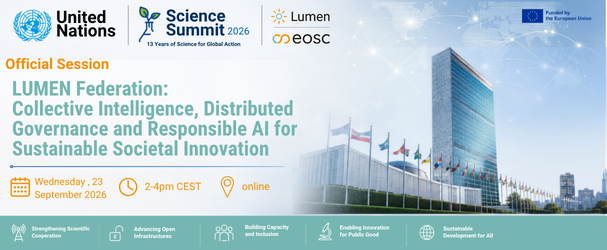
On 23 September 2026, LUMEN hosted an online session at the UN Science Summit 2026: The LUMEN Federation: Collective Intelligence, Distributed Governance and Responsible AI for Sustainable Societal Innovation. Across six thematic discussions, global perspectives and concrete LUMEN examples showed how scientific communities can work together, share knowledge and use AI responsibly, while staying open, trusted and resilient.
Introducing LUMEN: A Federation for Collective Intelligence
LUMEN coordinator Suzanne Dumouchel (CNRS) opened the session with a question that the talks addressed from different angles: how can scientific communities become collectively more intelligent without becoming collectively more centralised? She then gave a short introduction to LUMEN and its vision of a federation for collective intelligence. Watch Suzanne’s talk
Distributed Governance as an Enabler of Resilience and Scale
Mei Lin Fung, Vice Chair of the UN AI for Good Impact Steering Committee, followed by a video message. She argued that the response to the challenges of AI should come from connected communities learning from each other. Watch Mei Lin’s talk
Connecting Knowledge through Meta-Search and Knowledge Discovery
Julien Homo (Foxcub), LUMEN technical coordinator, showed how LUMEN is connecting disciplines, without centralising them: The LUMEN Data Mesh allows each scientific community to retain full ownership and governance of its data while making it findable and reusable across domains without moving it. Based on it, the LUMEN Meta-Search proposes candidate links between disciplines, such as seismic observations and a mathematical model of surface waves, for community experts to validate. Watch Julien’s talk
Christophe Gauthier (I4T Knowledge Network) presented the Global Periodic Table of Digital Platform Governance, a decentralised framework for sharing regulatory knowledge across diverse regions and disciplines. Watch Christophe’s talk
The Power of Collective Design and Co-Creation
Michela Magas (Industry Commons Foundation) opened this thematic part by highlighting the power of collective design and co-creation, drawing on a special issue of the CERN IdeaSquare Journal of Experimental Innovation devoted to the topic, which grew out of LUMEN’s Innovation Prototyping Labs. Watch Michela’s talk
Stefano De Paoli (Abertay University), who leads user research and co-design in LUMEN, explained how scientific communities have shaped and continue to shape the White-Label Platform. Interviews across LUMEN’s four scientific domains were used to create personas that capture shared needs and reveal common ground. Watch Stefano’s talk
Responsible AI in practice
Luca De Santis (Net7), who leads the development of the discovery platform, presented how LUMEN approaches responsible AI in practice, through the two AI assistants that support discovery on the White-Label Platform: Cogent, a notebook-style chatbot that lets users import content found on the discovery platform, and AIDA, a conversational discovery assistant. Watch Luca’s talk
Sarah Nicole (Project Liberty Institute) complemented this with a systemic view: In her talk, she stresses the importance of critical thinking in a world in which rules for responsible AI face strong contrary incentives, such as economic interests and geopolitical ambition.
Embedding Innovation within Open Science Ecosystems
Andrew Dubber (Industry Commons Foundation), who leads the development of the EOSC Innovation Centre, closed the session with a talk on how open science results can be sustained beyond the end of a project. He introduced the EOSC Innovation Centre, one of LUMEN’s key outcomes, as a possible answer: a programme of living labs, where communities test results together and work out who takes responsibility for them afterwards. Watch Andrew’s talk
Key takeaways
- Connection without centralisation: Resources can be made more discoverable while scientific communities keep control of their knowledge and practices.
- Technology must fit human practices: Tools only get used when they match how communities actually work.
- Co-creation needs attention to power: Participation does not automatically guarantee inclusion.
- Responsible AI starts with understanding: Critical thinking and clear design choices matter as much as technology.
- Infrastructures need continuity: Ownership, stewardship and support must be planned before a project ends.
What comes next
LUMEN will continue to test these ideas at the third Innovation Prototyping Lab in Paris in March 2027, exploring federation, co-creation and responsible AI.
Watch all the recordings of the session in a row: